
Lunar Eclipse August 28, 2026: Chandra Grahan Time, Visibility, Sutak & Rashi Effects
The partial lunar eclipse of August 28, 2026 occurs in Aquarius and Shatabhisha Nakshatra. Learn its timings, visibility in India, Sutak rules and possible effects on all 12 Moon signs.
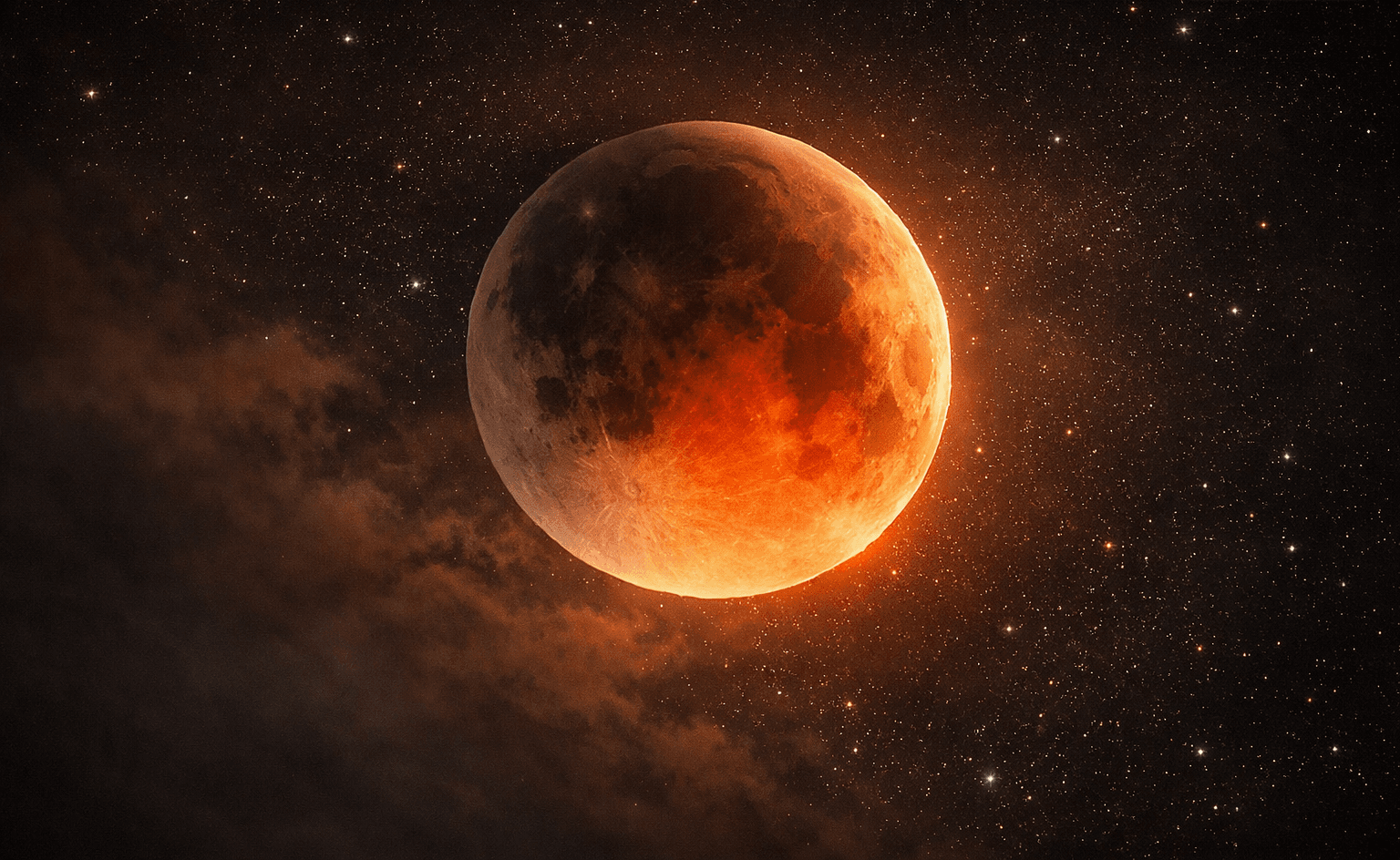
Lunar Eclipse on August 28, 2026
A partial lunar eclipse will occur on Friday, August 28, 2026.
A lunar eclipse takes place at Full Moon when Earth passes between the Sun and Moon. Earth’s shadow then falls across the lunar surface.
During a partial lunar eclipse, only part of the Moon enters Earth’s darker central shadow, known as the umbra. The rest of the Moon remains outside the deepest portion of the shadow.
The August 28 eclipse will be visible principally from the eastern Pacific, North and South America, Europe and Africa.
It will not be visible from India because the Moon will be below the horizon while the eclipse is taking place.
Using the Lahiri sidereal zodiac at the time of maximum eclipse, the Moon falls in Kumbha Rashi, or Aquarius, within Shatabhisha Nakshatra. The Sun stands opposite it in Leo, creating an eclipse across the Aquarius-Leo axis.
Lunar Eclipse August 28, 2026: Important Details
- Date: August 28, 2026
- Day: Friday
- Eclipse type: Partial lunar eclipse
- Greatest eclipse: Around 04:14 UTC
- Maximum in Indian time: Around 9:43–9:44 AM IST
- Partial phase duration: Approximately 3 hours 18 minutes
- Umbral magnitude: Approximately 0.93
- Moon’s sidereal sign: Aquarius
- Moon’s Nakshatra: Shatabhisha
- Sun’s sidereal sign: Leo
- Visibility in India: Not visible
- Sutak in India: Generally not applicable
Approximate Indian Standard Time equivalents for the global event are:
- Penumbral contact begins: Around 6:55 AM
- Partial eclipse begins: Around 8:04 AM
- Maximum eclipse: Around 9:43–9:44 AM
- Partial eclipse ends: Around 11:21 AM
- Penumbral contact ends: Around 12:30 PM
These times describe when the eclipse occurs globally. The Moon will not be visible above the Indian horizon during these phases.
Will the August 28 Lunar Eclipse Be Visible in India?
No.
Although the converted timings fall during the Indian morning, the Moon will already have set. The eclipse therefore cannot be observed from India.
It will be visible from many locations across the Americas, Europe, Africa and the eastern Pacific, subject to local weather and the Moon’s altitude.
Unlike a solar eclipse, a lunar eclipse is safe to observe with the naked eye. It does not require special glasses or filters.
Is Sutak Applicable in India?
Under the commonly used Panchang rule, Sutak is observed only when the eclipse is visible from the relevant location.
Because the August 28 lunar eclipse will not be visible in India, Sutak is generally not applicable in Indian cities.
People living in regions where the eclipse is visible should use a Panchang calculated for their own city. Eclipse visibility, moonrise, moonset and local tradition determine the relevant observance.
Lunar Eclipse in Vedic Astrology
The Moon is one of the most important factors in Jyotisha.
It signifies:
- mind,
- emotions,
- memory,
- mother,
- nourishment,
- habits,
- adaptability,
- sleep,
- mental peace,
- public response and everyday experience.
During a lunar eclipse, the Full Moon passes into Earth’s shadow near the Rahu-Ketu axis.
Symbolically, lunar clarity and emotional perception may become temporarily obscured. Feelings that were previously controlled or ignored may surface.
This does not mean that everyone will experience an emotional crisis.
The eclipse is most personally important when its degree closely touches:
- the natal Moon,
- Ascendant,
- Ascendant lord,
- Sun,
- Atmakaraka,
- Mahadasha or Antardasha lord,
- important planets in Aquarius, Leo or Shatabhisha.
For most people, the eclipse may pass without a clearly identifiable personal event.
Classical Perspective on Lunar Eclipses
Classical eclipse interpretation is more complex than declaring every eclipse good or bad for twelve signs.
Varahamihira’s Brihat Samhita considers the eclipse sign, Nakshatra, geographical visibility, duration, direction and collective associations. This framework is especially useful for mundane astrology involving countries, rulers, crops, weather, institutions and communities.
Individual horoscope analysis requires a different layer.
A personal interpretation should study:
- the house occupied by Aquarius,
- the house occupied by Leo,
- natal Rahu and Ketu,
- the condition of Saturn, ruler of Aquarius,
- the condition of the Sun and Moon,
- the eclipse degree,
- Mahadasha and Antardasha,
- relevant divisional charts.
Therefore, the following rashi forecasts are broad house-based indications, not guaranteed events or direct translations of ancient verses.
Why Aquarius and Shatabhisha Matter
Aquarius is a fixed air sign associated with:
- society,
- communities,
- networks,
- reform,
- systems,
- technology,
- collective responsibility,
- unusual ideas,
- long-term social change.
In Parashari astrology, Aquarius is ruled by Saturn.
Shatabhisha is ruled by Rahu and is associated with Varuna. Its symbolism includes concealment, observation, boundaries, medicine, healing, isolation, truth and the exposure of what is difficult to see.
The name is commonly interpreted in connection with a hundred healers or a hundred remedies, although its symbolism should not be reduced to literal medical promises.
An eclipse in Shatabhisha may highlight tension between personal isolation and collective belonging. It can expose flaws in networks, digital systems, friendships, institutional structures or personal coping mechanisms.
Because the Sun is opposite in Leo, another question emerges:
How can personal recognition and leadership coexist with the needs of the group?
The Aquarius-Leo Eclipse Axis
Aquarius and Leo represent complementary themes.
Leo relates to:
- personal identity,
- creative authority,
- recognition,
- leadership,
- self-expression.
Aquarius relates to:
- community,
- social networks,
- shared systems,
- reform,
- collective purpose.
The eclipse may reveal where individual ego and collective responsibility have become unbalanced.
Some people may have been sacrificing their identity to remain accepted by a group. Others may have been demanding recognition without contributing meaningfully to the larger system.
The constructive purpose of this axis is not to reject the individual or the community. It is to find a healthier relationship between them.
Effects of the August 28 Lunar Eclipse on All 12 Rashis
These interpretations are primarily based on the natal Moon sign. Use the Ascendant as a secondary reference for practical events.
Aries: Eclipse in the 11th House
For Aries Moon, the eclipse activates income, professional networks, friendships and long-term ambitions.
A group or friendship may change. You may discover that a goal pursued for social approval no longer feels meaningful.
Delayed gains or payments may require renewed follow-up.
Avoid making abrupt decisions based on temporary disappointment with a friend, audience or organisation. Review whether the network supports genuine long-term progress.
Taurus: Eclipse in the 10th House
For Taurus Moon, the eclipse activates career, reputation, authority and public responsibility.
A professional result, announcement or organisational change may become visible. You may feel emotionally uncertain about the direction of your career even when external progress continues.
Avoid reacting publicly before obtaining complete information.
This eclipse is more significant when the running dasha activates the tenth house, Saturn, Moon or Aquarius.
Gemini: Eclipse in the 9th House
For Gemini Moon, the eclipse activates higher education, teachers, beliefs, long-distance travel and legal matters.
An academic, legal or international plan may reach a turning point. Information that changes your understanding of a teacher, institution or belief system may emerge.
This can be a useful period for replacing borrowed opinions with carefully researched understanding.
Review travel and educational documents rather than assuming that administrative details are complete.
Cancer: Eclipse in the 8th House
For Cancer Moon, the eclipse activates shared finances, loans, taxes, inheritance, secrets and psychological vulnerability.
An emotional or financial matter that has remained hidden may require attention. Avoid secretive agreements and unclear liabilities.
The eclipse can also support investigation, therapy, research and honest discussion of fears that have been difficult to name.
Do not interpret every unexpected development as catastrophe. Preparation is more useful than fear.
Leo: Eclipse in the 7th House
For Leo Moon, the eclipse activates marriage, partnership, clients, agreements and public dealings.
Because the Sun stands on the opposite side of this eclipse axis, the balance between self-expression and partnership becomes especially important.
A relationship may require greater honesty about independence, recognition and shared responsibility.
Do not predict marriage, reconciliation or separation from the eclipse alone. The seventh lord, Venus, Jupiter, Navamsha and dasha must support such conclusions.
Virgo: Eclipse in the 6th House
For Virgo Moon, the eclipse activates work, routine, disputes, debts, competition and health habits.
A workplace issue or inefficient system may become visible. You may need to simplify your daily schedule rather than trying to manage every problem simultaneously.
Old tasks and obligations may return for completion.
For health concerns, seek appropriate professional care. Eclipse symbolism should never replace diagnosis or treatment.
Libra: Eclipse in the 5th House
For Libra Moon, the eclipse activates creativity, education, children, romance and speculation.
A romantic or creative matter may reach an emotional turning point. Students may reconsider a subject or method of study.
Matters involving children require patient listening rather than projecting personal expectations onto them.
Avoid speculative decisions made from excitement, disappointment or the desire to prove something.
Scorpio: Eclipse in the 4th House
For Scorpio Moon, the eclipse activates home, mother, property, residence and emotional security.
A domestic issue may reach a point where it can no longer be postponed. Repairs, family responsibilities or relocation plans may require attention.
Inner restlessness may reflect unresolved emotional pressure rather than an actual need to abandon everything.
Create practical stability at home before making major professional or relationship decisions.
Sagittarius: Eclipse in the 3rd House
For Sagittarius Moon, the eclipse activates communication, courage, writing, skills, media, siblings and short journeys.
A message, publication or conversation may produce an unexpected response. Old communication patterns may need revision.
This is a good time to consider whether you are communicating to create understanding or merely to defend your position.
Double-check schedules, documents and digital content before publication.
Capricorn: Eclipse in the 2nd House
For Capricorn Moon, the eclipse activates family, speech, food, savings and personal values.
Financial priorities may change. A family conversation can reveal an issue that has remained unspoken.
Use restraint in speech, especially when discussing money or responsibility.
The eclipse may help you distinguish stable values from obligations accepted only because of guilt, fear or family pressure.
Aquarius: Eclipse in the 1st House
Aquarius Moon natives experience the eclipse directly over their Janma Rashi.
Identity, emotional wellbeing, appearance, confidence and personal direction may feel more sensitive.
You may recognise that a role within a group, organisation or friendship no longer reflects your real priorities.
Avoid making permanent decisions during a temporary period of emotional intensity. Rest, maintain boundaries and obtain reliable information.
The effect becomes considerably more personal when the natal Moon or Ascendant lies close to the eclipse degree in Shatabhisha.
Pisces: Eclipse in the 12th House
For Pisces Moon, the eclipse activates expenses, sleep, solitude, foreign places, hospitals, retreat and release.
A hidden expense or emotional burden may become visible. Sleep and mental rest deserve attention.
This can be a useful period for completing private work, reducing unnecessary commitments and releasing a habit that consumes energy.
Solitude may be constructive, but complete withdrawal can make ordinary concerns feel larger than they are.
Which People May Feel This Eclipse Most Strongly?
The eclipse may be more personally important for people with:
- Moon in early or middle Aquarius,
- Ascendant in Aquarius near the eclipse degree,
- Sun or important planets in Aquarius,
- planets in the opposing part of Leo,
- planets in Shatabhisha Nakshatra,
- an active Moon, Saturn, Rahu, Sun or Aquarius-related dasha.
The exact degree relationship matters more than a broad zodiac label.
Does an Eclipse Automatically Bring Bad Results?
No.
An eclipse can coincide with uncertainty, revelation, culmination or redirection, but it does not guarantee disaster.
The final result depends on:
- natal promise,
- planetary dignity,
- house lordship,
- dasha,
- Ashtakavarga,
- divisional charts,
- later transits,
- personal decisions and circumstances.
A supportive dasha may convert emotional awareness into constructive change. A difficult dasha may require more patience and external support.
Fear is not a useful predictive method.
Spiritual Practices During the Eclipse
Since the eclipse will not be visible in India, formal Sutak is generally not required under the common visibility rule.
People who still wish to treat the date as a reflective period may choose:
- meditation,
- mantra japa,
- prayer,
- charity,
- journaling,
- silent contemplation,
- reducing conflict and unnecessary stimulation.
These are optional spiritual practices, not medical or scientific requirements.
People in regions where the eclipse is visible should follow their local Panchang and family tradition.
Frequently Asked Questions
When is the lunar eclipse in August 2026?
The partial lunar eclipse occurs on Friday, August 28, 2026.
What type of lunar eclipse is it?
It is a partial lunar eclipse. A large portion of the Moon enters Earth’s darker umbral shadow, but the entire lunar disc does not become totally eclipsed.
Will the lunar eclipse be visible in India?
No. The Moon will be below the horizon in India during the eclipse.
Is Sutak applicable in India?
Under the commonly followed visibility-based rule, Sutak is not applicable because the eclipse is not visible in India.
What time is the eclipse in India?
The global maximum corresponds to approximately 9:43–9:44 AM IST, but the Moon will not be visible from India at that time.
In which rashi does the lunar eclipse occur?
Using Lahiri sidereal calculations, the eclipsed Moon falls in Aquarius.
In which Nakshatra does it occur?
The Moon falls in Shatabhisha Nakshatra.
Which rashi is most directly affected?
Aquarius is the most directly activated general Moon sign, while Leo forms the opposite side of the eclipse axis. Exact natal degree contacts and dasha remain more important.
Is it safe to watch a lunar eclipse?
Yes. A lunar eclipse can be viewed safely with the naked eye, binoculars or a telescope.
Classical and Astronomical References
- Brihat Samhita, Rahu-chara section
- Brihat Parashara Hora Shastra
- Phaladeepika
- Saravali
- Jaimini principles for personalised chart analysis
- NASA lunar eclipse calculations and visibility data
Classical editions may differ in chapter and verse numbering. Verify any exact quotation against the edition cited in the final publication.