
Using Panchang for Daily Decisions: Tithi, Nakshatra, Rahu Kaal & Muhurat Guide
A Practical Guide to Choosing the Right Time. Learn how to use Panchang for daily decisions through Tithi, Nakshatra, Yoga, Karana, Rahu Kaal, Abhijit Muhurat, Hora, and practical timing rules.
In Vedic tradition, time is not seen as empty.
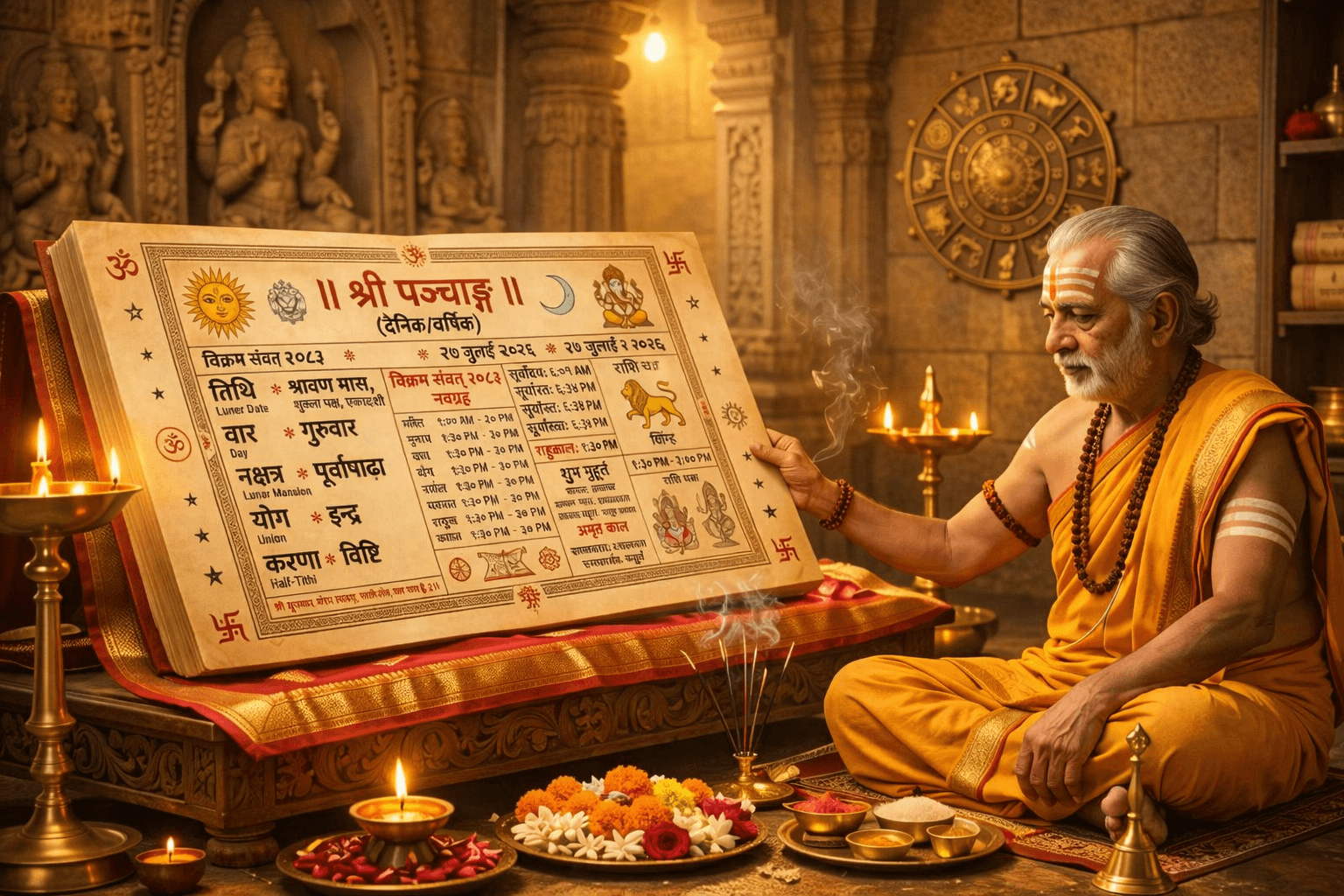
Every day carries a certain quality. Some moments are better for starting new work. Some are better for prayer, study, healing, travel, business, rest, or inner reflection. This understanding of time is preserved through the Daily Panchang.
A Panchang is the traditional Hindu calendar and daily astrological guide. It helps us understand the nature of a day through five main limbs: Tithi, Vara, Nakshatra, Yoga, and Karana.
Many people think Panchang is only used for festivals, weddings, or big ceremonies. But in reality, Panchang can also be used for simple daily decisions.
You can use it to choose a better time for:
- starting important work,
- making purchases,
- beginning travel,
- doing spiritual practice,
- scheduling meetings,
- signing agreements,
- performing puja,
- avoiding unnecessary conflict,
- understanding the mood of the day.
Using Panchang does not mean becoming fearful or superstitious. It means becoming more aware of time.
Just as farmers observe seasons before planting seeds, Panchang helps us observe the subtle quality of time before beginning important actions.
What Is Panchang?
The word Panchang comes from two Sanskrit words:
Pancha means five. Anga means limb or part.
So Panchang means “five limbs.”
These five limbs are:
- Tithi – lunar day
- Vara – weekday
- Nakshatra – lunar mansion
- Yoga – special Sun-Moon combination
- Karana – half of a Tithi
Together, these five factors describe the energetic quality of a day.
A Panchang also commonly includes:
- sunrise and sunset,
- moonrise and moonset,
- Rahu Kaal,
- Yamaganda,
- Gulika Kaal,
- Abhijit Muhurat,
- Choghadiya,
- Hora,
- festivals,
- vrats,
- planetary transits,
- auspicious and inauspicious timings.
For daily decisions, you do not need to understand everything at once. Start with the basics.
Why Panchang Matters in Daily Life
Most people make decisions only based on convenience.
For example:
“Am I free at 4 PM?” “Is the office open?” “Can everyone attend?”
These things matter, of course. But Panchang adds another layer:
“What kind of time is this?” “Is this moment supportive for the work I want to do?” “Should I start now or wait for a better time?”
In Vedic astrology, every action has a beginning point. The time at which something begins carries the imprint of that moment.
This is why Muhurat selection is important.
A marriage begins at a chosen time. A business begins at a chosen time. A journey begins at a chosen time. A puja begins at a chosen time. Even a serious conversation begins at a certain time.
Panchang helps us choose beginnings more consciously.
Panchang Is Not About Fear
Before going deeper, this point is important.
Panchang should not be used to create fear.
Not every small task requires a perfect Muhurat. You do not need to check Panchang before drinking water, sending every message, or doing ordinary daily work.
Panchang is most useful when the action has importance.
Use Panchang for decisions that matter, such as:
- starting a new project,
- launching a website,
- beginning a spiritual practice,
- buying valuable items,
- making a major announcement,
- traveling for an important purpose,
- signing important documents,
- choosing a date for ceremony or puja.
For normal routine tasks, practical common sense is enough.
The goal is not to become dependent on Panchang. The goal is to align important actions with better timing whenever possible.
The Five Main Parts of Panchang
To use Panchang properly, you must understand its five limbs.
Let’s go step by step.
1. Tithi: The Lunar Day
Tithi is one of the most important parts of Panchang.
It is based on the angular distance between the Sun and the Moon. In simple language, Tithi shows the lunar phase of the day.
There are 30 Tithis in one lunar month:
- 15 Tithis in Shukla Paksha,
- 15 Tithis in Krishna Paksha.
Shukla Paksha is the waxing phase of the Moon, from New Moon to Full Moon. Krishna Paksha is the waning phase of the Moon, from Full Moon to New Moon.
Tithi gives the emotional and spiritual tone of the day.
Some Tithis are better for growth, worship, learning, and prosperity. Some are better for discipline, clearing, repayment, austerity, or removal of obstacles.
For daily use, Tithi helps answer:
“Is today good for starting something?” “Is today better for worship or practical work?” “Is this a day of growth, completion, or withdrawal?”
How to Use Tithi in Daily Decisions
Here is a simple way to understand Tithis.
Pratipada
Good for beginnings, planning, and starting small steps.
Dwitiya
Good for cooperation, relationship-building, and gentle work.
Tritiya
Good for creativity, communication, writing, and learning.
Chaturthi
Often used for Lord Ganesha worship and obstacle removal. Better for solving problems than starting delicate work.
Panchami
Good for learning, healing, study, and spiritual growth.
Shashthi
Good for discipline, health routines, competition, and practical effort.
Saptami
Connected with vitality and the Sun. Good for health, authority, movement, and progress.
Ashtami
A powerful but intense Tithi. Good for spiritual discipline, protection, and inner strength. Not always preferred for soft or happy beginnings.
Navami
Energetic and sometimes sharp. Good for courage and decisive action, but avoid unnecessary conflict.
Dashami
Generally good for success, public work, professional matters, and forward movement.
Ekadashi
Excellent for fasting, spiritual practice, mantra, devotion, and self-control.
Dwadashi
Good for recovery, worship, charity, and peaceful completion.
Trayodashi
Often considered good for worship, prosperity, and refinement, depending on other factors.
Chaturdashi
Intense and transformative. Good for austerity, spiritual protection, and removing negativity.
Purnima
Full Moon. Good for worship, completion, gratitude, spiritual practice, and public activities.
Amavasya
New Moon. Good for ancestors, silence, inner work, charity, and spiritual reflection. Not usually preferred for major worldly beginnings.
This is a general guide. The final result depends on Nakshatra, weekday, Yoga, Karana, and Muhurat.
2. Vara: The Weekday
Vara means weekday.
Each weekday is ruled by a planet:
- Sunday – Sun
- Monday – Moon
- Tuesday – Mars
- Wednesday – Mercury
- Thursday – Jupiter
- Friday – Venus
- Saturday – Saturn
The weekday gives the planetary flavor of the day.
For example, Thursday carries Jupiter’s influence and is often good for learning, teaching, wisdom, guidance, worship, and blessings.
Friday carries Venus’s influence and is often good for beauty, relationships, art, comfort, purchases, and social harmony.
Saturday carries Saturn’s influence and is better for discipline, responsibility, serious work, service, cleaning, long-term planning, and karmic correction.
How to Use Weekdays in Daily Life
Sunday
Good for leadership, government work, health routines, visibility, authority, and confidence.
Monday
Good for emotional matters, family, home, water-related work, healing, devotion, and peaceful decisions.
Tuesday
Good for courage, competition, technical work, exercise, discipline, and decisive action. Avoid unnecessary fights.
Wednesday
Good for business, communication, writing, learning, trade, analysis, and meetings.
Thursday
Good for education, wisdom, finance planning, spiritual practice, guru-related work, marriage discussions, and blessings.
Friday
Good for relationships, art, beauty, luxury, comfort, music, design, purchases, and social events.
Saturday
Good for hard work, discipline, service, repairs, long-term commitments, debt management, and serious reflection.
This does not mean you cannot do other work on these days. It simply means each day supports certain actions more naturally.
3. Nakshatra: The Star of the Day
Nakshatra is one of the deepest parts of Panchang.
The Moon travels through 27 Nakshatras. Each Nakshatra has its own deity, symbol, nature, and psychological quality.
Nakshatra tells us the subtle mood of the day.
For daily decisions, Nakshatra can be even more practical than Tithi because it shows what kind of action the day supports.
Some Nakshatras are soft and good for relationships. Some are fixed and good for long-term work. Some are sharp and good for cutting, removal, surgery, or discipline. Some are movable and good for travel.
Types of Nakshatras for Daily Decisions
Nakshatras are traditionally classified by nature. This helps in choosing activities.
Fixed Nakshatras
Good for permanent work, property, long-term decisions, foundations, commitments, and stable actions.
Examples include Rohini, Uttara Phalguni, Uttara Ashadha, and Uttara Bhadrapada.
Movable Nakshatras
Good for travel, movement, business, change, vehicles, and flexible activities.
Examples include Swati, Punarvasu, Shravana, Dhanishta, and Shatabhisha.
Soft Nakshatras
Good for relationships, art, beauty, learning, music, friendship, romance, and gentle work.
Examples include Mrigashira, Chitra, Anuradha, and Revati.
Sharp Nakshatras
Good for cutting, separation, surgery, discipline, removing problems, and strong action. Not ideal for soft beginnings.
Examples include Ardra, Ashlesha, Jyeshtha, and Mula.
Fierce Nakshatras
Good for difficult tasks, protection, competition, and overcoming enemies. Avoid for peaceful ceremonies.
Examples include Bharani and Magha.
Light Nakshatras
Good for quick work, trade, learning, play, medicine, and short activities.
Examples include Ashwini, Pushya, and Hasta.
This classification makes Panchang more practical. Instead of asking “Is today good or bad?”, ask:
“What kind of work is today good for?”
That is the right way to use Nakshatra.
4. Yoga: The Subtle Combination
In Panchang, Yoga is calculated from the combined positions of the Sun and Moon.
There are 27 Yogas.
Yoga gives another layer of quality to the day. Some Yogas are considered auspicious and supportive. Some are more difficult or unstable.
For daily use, beginners do not need to memorize all 27 Yogas immediately.
Just notice whether the Panchang marks the Yoga as generally auspicious, mixed, or challenging.
If the Yoga is supportive, it can strengthen the day. If the Yoga is difficult, you may still do necessary work, but avoid starting very sensitive or major activities unless other factors are strong.
5. Karana: Half of a Tithi
Karana is half of a Tithi.
It is a smaller time division, but it is important in Muhurat.
Karana shows the practical execution energy of a moment.
Some Karanas are good for normal work, business, travel, and agreements. Some are avoided for auspicious beginnings.
For daily use, you do not need to overcomplicate Karana. But for important work, especially ceremonies, contracts, or major beginnings, Karana should be checked along with Tithi and Nakshatra.
Rahu Kaal: Time to Avoid for New Beginnings
Rahu Kaal is one of the most commonly checked parts of Panchang.
It is a daily period associated with Rahu. Traditionally, it is avoided for starting auspicious work.
You do not need to stop all activity during Rahu Kaal. If work is already ongoing, it can continue. Routine tasks can also be done.
But it is better to avoid starting major new activities during Rahu Kaal, such as:
- signing important agreements,
- beginning a new business,
- launching a product,
- starting a journey for an important purpose,
- performing auspicious ceremonies,
- making major purchases.
Rahu Kaal changes every day because it is calculated based on sunrise and sunset.
This is why using a location-based Panchang is important.
Yamaganda and Gulika Kaal
Along with Rahu Kaal, Panchang also shows Yamaganda and Gulika Kaal.
Yamaganda
Yamaganda is generally avoided for auspicious beginnings. It is considered unsuitable for starting important positive work.
Gulika Kaal
Gulika Kaal is associated with Saturn-like energy. It may be useful for certain serious, repetitive, or karmic activities, but it is not usually preferred for auspicious beginnings.
For simple daily use, remember this:
Avoid starting major auspicious work during Rahu Kaal, Yamaganda, and Gulika Kaal when possible.
If the work is unavoidable, do it with calmness, prayer, and practical care.
Abhijit Muhurat: A Helpful Daily Window
Abhijit Muhurat is considered one of the most useful daily Muhurats. You can check it inside the Daily Panchang.
It usually occurs around midday, depending on local sunrise and sunset.
When a person cannot find a perfect Muhurat, Abhijit Muhurat is often used for important work, provided there are no serious conflicting factors.
It can be used for:
- starting important tasks,
- meetings,
- applications,
- purchases,
- professional decisions,
- spiritual activities,
- resolving pending work.
However, Abhijit Muhurat is not used blindly for every situation. For marriage and highly specialized ceremonies, a proper Muhurat should still be selected.
For daily life, though, Abhijit Muhurat is one of the easiest Panchang tools to use.
Hora: Choosing the Right Planetary Hour
Hora divides the day and night into planetary hours.
Each Hora is ruled by a planet.
For daily decisions, Hora is very practical.
Sun Hora
Good for authority, government work, leadership, confidence, and official matters.
Moon Hora
Good for emotional matters, home, family, water, care, peace, and public interaction.
Mars Hora
Good for courage, exercise, competition, technical work, and decisive action.
Mercury Hora
Good for communication, business, writing, study, calculation, and negotiation.
Jupiter Hora
Good for learning, finance planning, teaching, blessings, spiritual work, and guidance.
Venus Hora
Good for art, relationships, beauty, comfort, luxury, social meetings, and purchases.
Saturn Hora
Good for discipline, labor, service, repairs, long-term planning, and serious work.
If you want to send a business proposal, Mercury Hora may be suitable. If you want to begin study, Jupiter Hora may be better. If you want to clean, organize, or handle pending duties, Saturn Hora may help. If you want to buy something beautiful or plan a social event, Venus Hora may be suitable.
Hora is one of the easiest ways to apply Panchang in modern life.
How to Use Panchang for Different Daily Decisions
Now let’s make this practical.
Starting New Work
For starting new work, check:
- Tithi,
- Nakshatra,
- Rahu Kaal,
- Yamaganda,
- Gulika,
- Abhijit Muhurat,
- suitable Hora.
Prefer a clean and supportive time.
Avoid starting during Rahu Kaal unless unavoidable.
For professional work, Wednesday, Thursday, and Friday are often easier depending on the nature of the work.
For disciplined or long-term work, Saturday can also be useful.
Business and Money Decisions
For business decisions, look for:
- Mercury Hora,
- Jupiter Hora,
- supportive Tithi,
- good Nakshatra,
- avoidance of Rahu Kaal.
Mercury supports trade, communication, calculation, and negotiation.
Jupiter supports wisdom, finance, expansion, and ethical decision-making.
Venus can help in luxury, beauty, design, entertainment, fashion, hospitality, and customer-facing businesses.
Avoid making major financial decisions when the mind is disturbed, even if the Panchang looks good.
Panchang supports judgment. It does not replace judgment.
Travel
For travel, check:
- Nakshatra,
- Tithi,
- Rahu Kaal,
- direction-related rules if followed traditionally,
- Moon condition,
- practical travel safety.
Movable Nakshatras are generally better for travel.
Avoid beginning important travel during Rahu Kaal if possible.
If travel cannot be delayed, begin with prayer, clarity, and preparation.
Study and Learning
For study, choose:
- Thursday,
- Wednesday,
- Jupiter Hora,
- Mercury Hora,
- Panchami,
- Ekadashi,
- supportive Nakshatras.
Jupiter helps wisdom. Mercury helps learning and memory.
For mantra, scripture, meditation, or spiritual learning, Thursday and Ekadashi can be especially meaningful.
Puja and Spiritual Practice
For puja, mantra, vrat, meditation, and inner work, Panchang is very useful.
Good factors include:
- Ekadashi,
- Purnima,
- Amavasya for ancestor-related practices,
- Thursday,
- Monday,
- Jupiter Hora,
- Moon Hora,
- suitable Nakshatra,
- sunrise period,
- Brahma Muhurat.
Brahma Muhurat, before sunrise, is traditionally considered excellent for meditation, mantra, study, and spiritual discipline.
Even if someone cannot follow detailed Panchang every day, waking early and doing prayer or meditation during a peaceful time is highly beneficial.
Buying Important Items
For purchases, especially valuable ones, check:
- Tithi,
- Nakshatra,
- weekday,
- Hora,
- Rahu Kaal.
For beauty, clothes, jewelry, vehicles, home decoration, or luxury items, Venus-related times may be supportive.
For books, education, tools, or business equipment, Mercury or Jupiter Hora may be useful.
For land, machinery, tools, or technical equipment, Mars or Saturn may sometimes be relevant depending on the item.
Avoid unnecessary impulsive purchases during disturbed mental states.
Medical Appointments and Health Routines
For ordinary medical needs, practical urgency comes first. Do not delay necessary care just because of Panchang.
But for non-urgent health routines, you may choose supportive times for:
- beginning exercise,
- starting disciplined diet,
- health checkups,
- yoga,
- meditation,
- healing practices.
Sunday can support vitality. Monday can support emotional healing. Tuesday can support exercise and strength. Saturday can support discipline and long-term routine.
Panchang should support health decisions, not obstruct them.
Important Conversations
For important conversations, choose calmer times.
Avoid moments when you feel angry, emotionally disturbed, or rushed.
Panchang-wise, Mercury Hora can support communication. Jupiter Hora can support wisdom and fairness. Moon Hora can support emotional understanding. Venus Hora can support harmony.
Avoid starting sensitive conversations during highly agitated personal moods, regardless of Panchang.
The best Muhurat for a conversation is a calm mind.
A Simple Daily Panchang Routine
If you want to use Panchang daily without getting overwhelmed, follow this simple routine.
Every morning, check:
- What is today’s Tithi?
- What is today’s Nakshatra?
- When is Rahu Kaal?
- Is there Abhijit Muhurat today?
- Which Hora supports my main task?
That is enough for most people.
You do not need to analyze every detail.
For example:
If you have an important email to send, avoid Rahu Kaal and choose Mercury Hora or Jupiter Hora.
If you want to begin spiritual practice, choose Brahma Muhurat, Thursday, Ekadashi, or Jupiter Hora.
If you want to make a purchase, choose Venus Hora or a supportive Nakshatra.
If you want to begin a disciplined routine, choose Saturn Hora, Tuesday, or a stable Nakshatra.
This is practical Panchang.
Panchang and Modern Life
Modern life is fast. Not everyone can wait for the perfect time.
That is okay.
Panchang should be used intelligently.
If your exam is at 10 AM, you cannot change it because of Rahu Kaal.
If your flight is scheduled, you may not be able to change it.
If a doctor appointment is urgent, health comes first.
In such cases, Panchang can still help you prepare mentally and spiritually. You can pray, stay calm, avoid unnecessary conflict, and act with awareness.
Panchang is not meant to make life rigid.
It is meant to make life more conscious.
Panchang vs Muhurat
Panchang and Muhurat are related but not the same.
Panchang shows the daily astrological factors.
Muhurat is the selection of a specific auspicious time for a specific activity.
For example, Panchang may tell you today’s Tithi, Nakshatra, Yoga, Karana, Rahu Kaal, and Abhijit Muhurat.
But Muhurat selection for marriage, housewarming, business opening, or major ceremony requires deeper analysis.
A proper Muhurat may consider:
- Panchang,
- Lagna at the selected time,
- planetary strength,
- avoidance of doshas,
- nature of the activity,
- birth charts of involved people,
- regional tradition.
So daily Panchang is useful for everyday decisions, but major life events should use proper Muhurat selection.
Common Mistakes While Using Panchang
Mistake 1: Looking Only at Rahu Kaal
Many people check only Rahu Kaal and ignore everything else.
Rahu Kaal is important, but Panchang has many layers. Tithi, Nakshatra, weekday, and Hora also matter.
Mistake 2: Thinking the Whole Day Is Good or Bad
A day is rarely completely good or completely bad.
One part of the day may be suitable for spiritual practice. Another may be better for business. Another may be unsuitable for beginnings.
The right question is not “Is today good?” The right question is “Good for what?”
Mistake 3: Ignoring Location
Panchang timings depend on location.
Sunrise, sunset, Rahu Kaal, Muhurat, and other timings change from place to place.
Always use a Panchang calculated for your city.
Mistake 4: Becoming Fearful
Panchang should create awareness, not anxiety.
If you miss a good time, do not panic. If you must act during a difficult time, act with care.
Your intention, preparation, karma, and effort also matter.
Mistake 5: Using Panchang Without Practical Judgment
Even a good Muhurat cannot fix poor planning.
If you launch a product at a good time but the product is not ready, problems will still come.
Panchang supports action. It does not replace effort.
How Parashar Hora Helps You Use Panchang
A good Panchang should be simple, accurate, and location-based.
With Parashar Hora, you can open the Daily Panchang and check details such as:
- Tithi,
- Nakshatra,
- Yoga,
- Karana,
- sunrise and sunset,
- Rahu Kaal,
- Yamaganda,
- Gulika Kaal,
- Abhijit Muhurat,
- Hora,
- planetary transits,
- daily Rashifal.
This makes it easier to plan your day without getting lost in technical details.
Instead of reading Panchang mechanically, use it as a guide.
Ask:
“What is the main energy of today?” “What should I avoid starting?” “What is the best time for my important task?” “What activity does today naturally support?”
That is the correct way to use Panchang.
Final Thoughts
Panchang is one of the most practical tools in Vedic astrology.
It teaches us that time has quality. Every day is not the same. Every hour is not the same. Some moments support growth. Some support discipline. Some support worship. Some support silence. Some support action.
Using Panchang does not mean surrendering your intelligence. It means adding timing awareness to your decisions.
For daily life, start simply.
Check the Tithi. Check the Nakshatra. Avoid Rahu Kaal for important beginnings. Use Abhijit Muhurat when needed. Choose a suitable Hora for your task. Use common sense. Act with clarity.
Panchang works best when combined with preparation, right intention, and sincere effort.
Good timing helps, but good karma and good action matter too.
Frequently Asked Questions
What is Panchang used for?
Panchang is used to understand the quality of a day and choose suitable times for activities such as puja, travel, business, study, purchases, ceremonies, and important beginnings.
What are the five parts of Panchang?
The five parts of Panchang are Tithi, Vara, Nakshatra, Yoga, and Karana.
Should I avoid all work during Rahu Kaal?
No. Routine work can continue during Rahu Kaal. Traditionally, Rahu Kaal is avoided mainly for starting important or auspicious new activities.
Is Abhijit Muhurat good for all work?
Abhijit Muhurat is generally considered supportive for many important tasks, but specialized events like marriage or housewarming still require proper Muhurat analysis.
Can Panchang help in business decisions?
Yes, Panchang can help choose better timing for business launches, meetings, proposals, purchases, and agreements. However, planning and practical judgment remain essential.
Is Panchang location-specific?
Yes. Panchang timings depend on sunrise and sunset, so they change according to location. Always use Panchang calculated for your city.
Which is more important: Tithi or Nakshatra?
Both are important. Tithi shows the lunar phase and emotional quality of the day. Nakshatra shows the subtle nature of actions supported by the day.
Can I use Panchang every day?
Yes. You can use Panchang daily by checking Tithi, Nakshatra, Rahu Kaal, Abhijit Muhurat, and Hora. For major life events, consult a detailed Muhurat.