
What Is Lagna in Vedic Astrology? Ascendant Meaning and Importance
Learn what Lagna or Ascendant means in Vedic astrology, how it is calculated, why birth time matters, how Lagnesh shapes the chart and how Lagna differs from Moon sign.
What Is Lagna in Vedic Astrology?
In Vedic astrology, Lagna is the zodiac sign rising on the eastern horizon at the exact time and place of a person’s birth.
It is commonly translated into English as the Ascendant or Rising Sign.
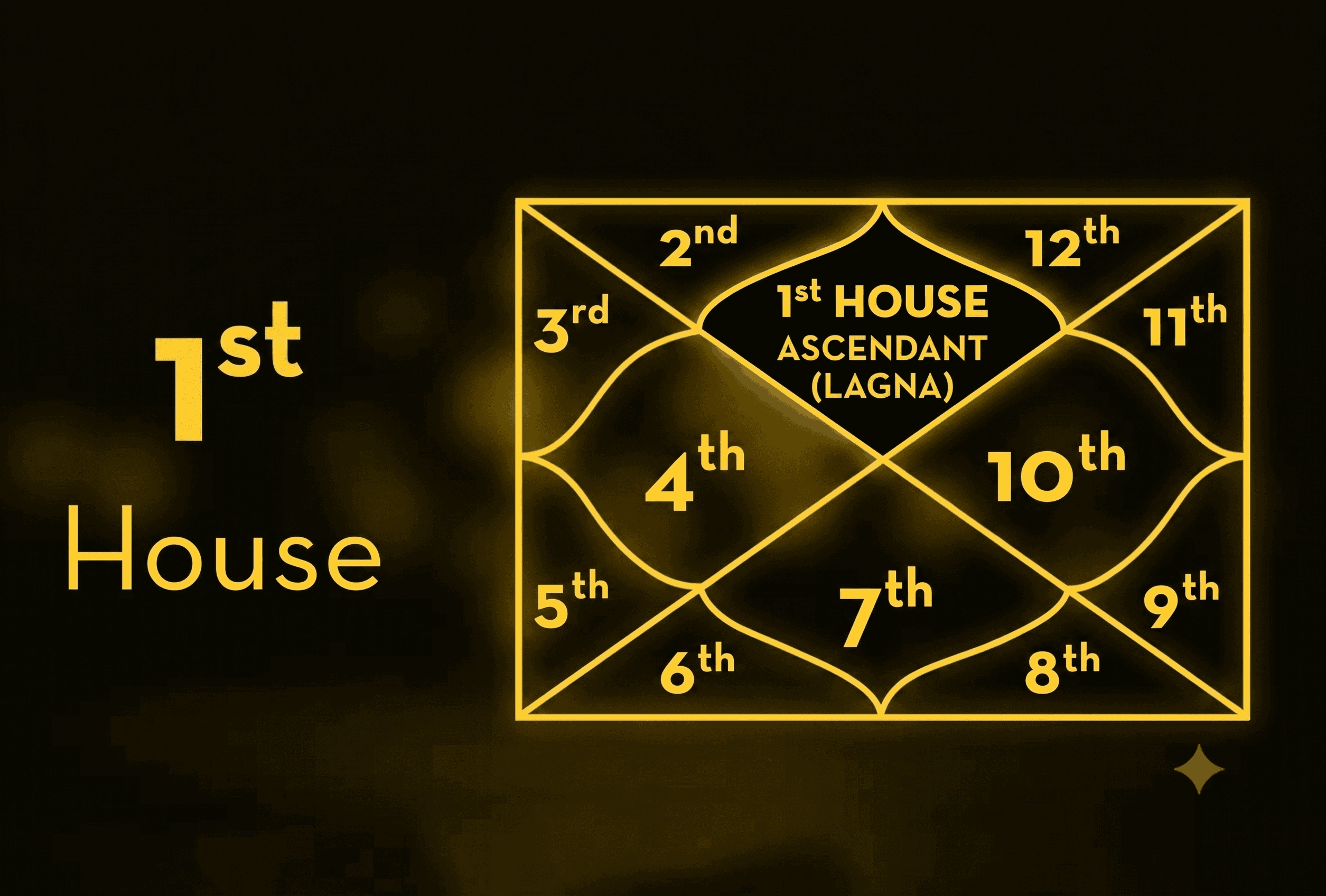
When a child is born, one particular part of the zodiac is appearing over the eastern horizon. The sign occupying that position becomes the first house of the birth chart. From there, the remaining houses are arranged in sequence.
This makes Lagna one of the most important foundations of a Kundli.
Your Moon sign describes the condition and habits of the mind. The Sun represents identity, purpose, vitality and authority. Lagna describes how life begins to unfold through the body, circumstances, personality and direct experience.
A birth chart without an accurate Lagna is like a house without a clearly marked entrance. The planets may still be present, but we may not know which part of life each planet is influencing.
Lagna Meaning in Simple Words
Lagna shows the point where the sky and the individual life meet at birth.
It is associated with:
- physical constitution;
- appearance and manner;
- health and vitality;
- temperament;
- natural approach to life;
- self-image;
- early environment;
- the direction in which life develops.
However, Lagna should not be reduced to appearance or personality alone.
It also establishes the twelve houses of the horoscope. A change in Lagna can change the house position and functional role of every planet in the chart.
For example, Jupiter may rule different houses for Aries Lagna and Cancer Lagna. Saturn may become a functional benefic for one Ascendant and a more difficult planet for another.
This is why Vedic astrology cannot be interpreted accurately by looking only at a person’s zodiac sign.
How Is Lagna Calculated?
Lagna is calculated using:
- date of birth;
- exact birth time;
- birthplace;
- geographical latitude and longitude;
- local time zone;
- daylight-saving correction where applicable;
- the chosen Ayanamsha in sidereal astrology.
The Earth rotates throughout the day, causing different zodiac signs to rise over the eastern horizon.
One Lagna remains active for roughly two hours on average. However, every sign does not rise for exactly the same duration. The rising time can vary according to geographical latitude and the sign’s position on the ecliptic.
This means that two people born in the same city on the same date may have different Lagnas when their birth times are a few hours apart.
Even a difference of several minutes can matter when the birth occurs close to a Lagna transition.
Generate a location-based birth Kundli to see the Ascendant calculated from the entered birth details.
Why Is the Exact Birth Time Important?
The birth date tells us where the planets were in the zodiac, but the birth time determines how those planets are placed within the houses.
An inaccurate time can change:
- the Lagna sign;
- the degree of the Ascendant;
- the houses occupied by planets;
- house lordships;
- divisional charts;
- sensitive points;
- predictions based on Dashas and transits.
Suppose someone is born when Taurus is about to stop rising and Gemini is about to begin.
A small difference in the recorded time may produce two completely different chart structures. Venus becomes the Lagna lord in a Taurus chart, while Mercury becomes the Lagna lord in a Gemini chart.
Therefore, uncertain birth time should be acknowledged honestly. It should not be hidden merely to produce a confident prediction.
Where necessary, astrologers may attempt birth-time rectification by comparing possible charts with major events in the person’s life. Rectification is an interpretive process and should not be presented as mathematically certain.
Lagna, Rashi and Sun Sign: What Is the Difference?
These three are often confused, but they represent different parts of the horoscope.
| Factor | Meaning |
|---|---|
| Lagna | The sign rising in the east at birth; establishes the houses and physical life |
| Rashi or Moon sign | The sign occupied by the Moon; connected with mind, habits and emotional response |
| Sun sign | The sign occupied by the Sun; connected with vitality, identity, authority and purpose |
Lagna
Lagna is strongly connected with the physical body, personal circumstances and the way the individual engages with life.
Moon Sign
The Moon sign reveals how experiences are processed emotionally. It is especially important in Vedic transit analysis and psychological interpretation.
Sun Sign
The Sun shows confidence, dignity, self-expression, father or authority themes and the desire to live with purpose.
A complete reading should not force these three into competition. They describe different layers of the same person.
Why Is Lagna So Important?
It determines the first house
The sign rising at birth becomes the first house. The next sign becomes the second house, followed by the third and so on.
Therefore, Lagna creates the basic structure of the chart.
It decides house lordships
Each sign is ruled by a planet. Once the Ascendant is known, astrologers can determine which planet rules each house.
The same planet can produce different results for different Lagnas because its house ownership changes.
It represents the physical vehicle of life
Every experience must eventually be lived through the body and personal circumstances.
A promising planetary combination is more useful when the Lagna and Lagna lord are capable of supporting it.
It becomes the main reference point
Classical Jyotisha texts repeatedly examine planets, houses and combinations from the Lagna. The Moon may also be used as an additional reference, but Lagna remains central to assessing embodied life and worldly experience.
What Is the Lagna Lord or Lagnesh?
The planet ruling the Ascendant sign is called the Lagna lord or Lagnesh.
For example:
| Lagna | Lagna Lord |
|---|---|
| Aries | Mars |
| Taurus | Venus |
| Gemini | Mercury |
| Cancer | Moon |
| Leo | Sun |
| Virgo | Mercury |
| Libra | Venus |
| Scorpio | Mars |
| Sagittarius | Jupiter |
| Capricorn | Saturn |
| Aquarius | Saturn |
| Pisces | Jupiter |
The condition of the Lagna lord is extremely important.
An astrologer examines:
- the house occupied by the Lagna lord;
- its sign and dignity;
- conjunctions;
- aspects received and given;
- combustion;
- retrograde condition where relevant;
- strength in divisional charts;
- its Nakshatra;
- active Dasha and transit conditions.
A strong Lagna lord may give resilience, direction and the ability to recover after difficulty.
A troubled Lagna lord does not mean that the person is doomed. It may indicate an area requiring greater effort, health awareness, maturity or support.
How Should Lagna Be Judged?
A meaningful Lagna analysis requires several layers.
1. The Ascendant sign
The rising sign gives the basic style through which a person approaches life.
A fire Lagna may respond through initiative and action. An earth Lagna may seek stability and practical results. An air Lagna may process life through ideas and interaction, while a water Lagna may be more sensitive to emotion and atmosphere.
These are broad tendencies, not fixed personality boxes.
2. The degree of Lagna
The exact degree helps determine:
- the Ascendant Nakshatra;
- Pada;
- divisional-chart placement;
- proximity to the next sign;
- sensitive planetary influences.
Two people with the same Lagna sign may still behave differently because their Ascendant degrees and Nakshatras are different.
3. The Lagna lord
The Lagna lord shows where the energy of the first house travels.
For example, when the Lagna lord is in the tenth house, identity may become strongly linked with work, public duty or achievement. When placed in the fourth house, home, inner security, education or property may become more central.
The final result depends on dignity, aspects, conjunctions and the entire chart.
4. Planets placed in Lagna
A planet in the first house strongly colours behaviour, appearance and life direction.
Jupiter in Lagna may encourage learning or guidance. Mars may increase action and competitiveness. Saturn may produce seriousness, patience or delayed self-confidence.
No placement should be judged from one keyword. House lordship and planetary condition must also be considered.
5. Aspects on Lagna
Planets influencing the first house can affect health, confidence, conduct and the way a person is perceived.
Supportive influences may strengthen stability, while difficult influences may create pressure that eventually develops resilience or discipline.
6. Navamsha and other divisional charts
The birth chart shows the main life structure, but divisional charts help refine the interpretation.
The Navamsha can reveal deeper planetary strength and how a planet matures. However, divisional charts depend heavily on accurate birth time and should not replace the main chart.
7. Dasha and transit activation
A birth chart contains many possibilities, but not all of them operate with equal intensity throughout life.
The natal chart shows the promise. The Dasha indicates what is active. Transits show what is being triggered at a particular time.
View your Vimshottari Dasha and personal planetary transits alongside the birth chart.
General Nature of the Twelve Lagnas
These descriptions are broad starting points. The Lagna lord, planets and aspects can significantly modify them.
Aries Lagna
Aries Lagna often approaches life through action, initiative and directness. Patience and measured decision-making may become important areas of growth.
Taurus Lagna
Taurus Lagna usually values stability, continuity, comfort and practical security. It may resist change until change becomes unavoidable.
Gemini Lagna
Gemini Lagna tends to engage through curiosity, communication and adaptability. The challenge may be maintaining focus and emotional consistency.
Cancer Lagna
Cancer Lagna is often sensitive to family, security and emotional atmosphere. Strong boundaries may be necessary to prevent excessive emotional absorption.
Leo Lagna
Leo Lagna may seek dignity, visibility, creativity and purposeful self-expression. Healthy leadership requires listening as well as confidence.
Virgo Lagna
Virgo Lagna often notices details, systems and areas that need improvement. Excessive self-criticism may need to be balanced with acceptance.
Libra Lagna
Libra Lagna usually seeks balance, cooperation and fairness. Decision-making can become difficult when harmony is valued more than clarity.
Scorpio Lagna
Scorpio Lagna may approach life with intensity, privacy and strong survival instincts. Trust and constructive emotional expression become important themes.
Sagittarius Lagna
Sagittarius Lagna tends to value knowledge, freedom, principles and exploration. Beliefs become more useful when they remain open to experience and correction.
Capricorn Lagna
Capricorn Lagna often develops through responsibility, patience and long-term effort. Progress may feel slow initially but become more stable with maturity.
Aquarius Lagna
Aquarius Lagna may be drawn toward systems, communities, ideas and social questions. Emotional distance should not replace genuine connection.
Pisces Lagna
Pisces Lagna can be imaginative, compassionate and receptive. Practical boundaries and consistent routines help its sensitivity become constructive.
Does a Strong Lagna Guarantee an Easy Life?
No.
A strong Lagna may improve vitality, confidence and the ability to handle pressure, but it does not remove every challenge.
Similarly, a weak or afflicted Lagna does not mean failure.
Astrology should examine:
- whether support arrives through benefic aspects;
- whether the Lagna lord improves in the Navamsha;
- whether helpful Yogas are present;
- which Dashas are operating;
- whether the person develops habits that strengthen health and judgment.
A chart should describe the pattern of effort and opportunity, not declare that a person is permanently limited.
Can Two People with the Same Lagna Have Different Lives?
Yes.
Millions of people share the same Ascendant sign, but they do not have identical lives because their charts differ in:
- Ascendant degree;
- planetary positions;
- Nakshatras;
- house lord placements;
- divisional charts;
- Dashas;
- transits;
- family environment;
- education and decisions.
Lagna is the doorway into the chart, not the entire building.
What Happens When Birth Time Is Unknown?
Without birth time, an astrologer may still examine planetary sign positions and sometimes the Moon chart.
However, the following may remain uncertain:
- Ascendant;
- houses;
- house lordships;
- divisional charts;
- location-specific Yogas;
- some Dasha refinements.
It is better to say that Lagna is unknown than to guess one from personality alone.
Personality descriptions are broad enough to fit many Ascendants, and life experiences are shaped by multiple planets.
Common Mistakes While Understanding Lagna
Treating Lagna as a personality label
Lagna is not merely a twelve-category personality test. It establishes the complete house structure of the horoscope.
Ignoring the Lagna lord
Reading the rising sign without examining its ruler gives only a partial picture.
Judging one planet in isolation
A planet placed in Lagna may behave differently depending on ownership, dignity, aspects and Dasha.
Using inaccurate birth time
A visually impressive chart is not necessarily an accurate chart. Birth details must be checked carefully.
Predicting only from the Sun sign
Sun-sign astrology may offer general themes, but it cannot replace a complete Vedic birth chart.
Treating difficult combinations as permanent punishment
Planetary pressure may describe challenges, delays or responsibilities. It should not be used to create fear or hopelessness.
The Deeper Meaning of Lagna
Lagna is the moment when possibility becomes personal.
The sky contains all twelve signs, but at birth one sign rises and becomes the entrance through which life is experienced.
That does not mean destiny is fixed in every detail.
Lagna describes the instrument we begin with: the body, temperament, environment and basic way of meeting the world.
How that instrument is used still depends on awareness, decisions, discipline, relationships and circumstances.
In that sense, Lagna is not a label placed upon a person.
It is the opening sentence of a much longer story.
Frequently Asked Questions
What is Lagna?
Lagna is the zodiac sign rising on the eastern horizon at the exact time and place of birth.
Is Lagna the same as the Moon sign?
No. Lagna establishes the houses and represents embodied life, while the Moon sign is connected with the mind and emotional response.
How often does Lagna change?
It changes roughly every two hours on average, although the exact duration varies by location and sign.
Why is birth time necessary?
Birth time determines the rising sign, house structure and divisional-chart calculations.
What is Lagnesh?
Lagnesh is the planet ruling the Lagna sign.
Which is more important: Lagna or Rashi?
Both are important for different reasons. Lagna is central to houses and physical life, while Rashi or Moon sign is central to mental and emotional experience.
Can Lagna change within a few minutes?
Yes, when birth occurs close to the transition between two rising signs.
Can astrology be done without Lagna?
Limited analysis may be possible from the Moon and planetary signs, but house-based interpretation becomes uncertain.